
This post may contain affiliate links. If you make a purchase through links on our site, we may earn a commission.
Plenty of gardeners will admit that growing wine cap mushrooms was their gateway to an unexpected new obsession with mushroom cultivation. Considering how rewarding growing wine cap mushrooms can be, that’s really no surprise. For me it was a shiitake mushroom kit that piqued my interest in growing other mushrooms, like wine caps. With their bright red mushroom caps and creamy white stems, the mushrooms themselves are visually striking. They’re also among the easiest mushrooms to start in outdoor garden beds, along pathways, on layers of cardboard and straw, and via many other substrates.
The wine cap mushroom is notable, too, for its environmental and health benefits as well as for its sheer novelty. (If not harvested early, this garden giant can grow to more than six inches tall and can weigh in at three to five pounds!).

Meet the wine cap
Red wine cap mushrooms are known by the scientific name Stropharia rugosoannulata (or Stropharia rugoso-annulata.) They’re also called King stropharia mushrooms, burgundy caps, or garden giants.
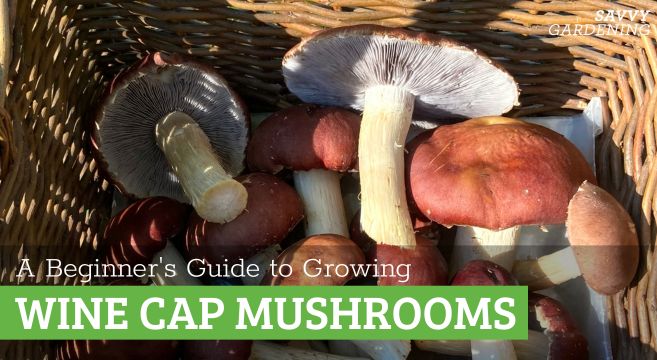
Emerging as red-wine or brick-colored lumps, they rise up on thick, light-colored stalks. As each mushroom matures, its cap breaks away from its veil, expanding to reveal spore-releasing gills. (The ring you see around an older mushroom’s stalk is actually a remnant of the now-broken veil.) At maturity, these mushrooms release spores and their colorful caps often fade from bright burgundy to a purplish-tan.
Wine caps can taste a bit like shiitake or oyster mushrooms. When they are young, they have an extra-rich, cashew-like flavor.

Just remember, because some people are more sensitive to chitin and other substances commonly found in edible mushrooms, it’s a good idea to try a small sample at first. Furthermore, some mycologists note that digestive upset is possible if you eat wine caps two or three days consecutively. In Growing Gourmet and Medicinal Mushrooms, author Paul Stamets explains, “From European reports, some individuals who daily consumed this mushroom, failed to rebuild the enzymes necessary for digestion, an event possibly potentiated by alcohol, and resulting in a bad case of indigestion and/or nausea.” Thankfully, this reaction appears to be fairly rare.
Add wine caps to your favorite vegetable dish or pasta recipe, sauté them with butter, garlic, and a dash of salt, or simply enjoy them pan-fried.
Why you should consider growing wine cap mushrooms
Wine caps are packed with protein and have a thick, meaty texture which makes them well-suited for many vegan and vegetarian recipes. But, their culinary value aside, some other good reasons for growing wine cap mushrooms include:
- Health benefits: Wine cap mushrooms are a high-fiber, low-fat food rich in many essential vitamins and minerals. They’ve also been shown to have antibacterial and antioxidant properties.
- Environmental uses: Wine cap mushrooms churn through bacteria as they grow and they’ve even been used as filters to help keep potentially harmful waste products like fecal coliform out of watersheds.
- Garden novelty: You can mix wine cap spawn with the mulch around your favorite annual flowers or within permanent beds of perennials for added visual interest, and to help with weed suppression, too. Harvest and eat some of the young mushrooms and let the rest grow extra large, just for fun.
- Versatility: Wine caps can grow on many different kinds of organic matter. You can use them to dispose of garden waste, shredded or chipped tree trimmings, and even old cardboard. Better yet, the soil they leave behind is richer in nutrients and structurally improved.

The best substrates for growing wine cap mushrooms
Choosing a suitable substrate is important when growing wine cap mushrooms. Fortunately, these burgundy-capped beauties are less picky about their growing medium than many other mushrooms. They’ll grow well in a mixture of soft and hardwood chips and weed-free oat or wheat straw. You can grow them directly on the ground in a dedicated wine cap mushroom bed or in a large container or raised bed garden.
When to “plant” wine cap spawn/spores
It’s best to inoculate your chosen growing medium with wine cap spores in the spring, but, as long as you don’t let a newly inoculated patch get too dry, summer and fall can also work. Just don’t plant too close to winter, since you want the mushroom’s vast underground rootlike network—its mycelium—to have time to become well-established before potential killing frosts come along.
How to cultivate wine caps
The spawn you’ll need for growing wine cap mushrooms is commercially available from professional mushroom growers. Typically, they inoculate sawdust with cultured wine cap mushroom spores. Once the sawdust is replete with wine cap mycelia, it’s sold as packaged wine cap mushroom sawdust spawn. (Sometimes wine cap mycelia are grown on certain kinds of spent grains as with this Wine Cap Garden Kit. It’s intended to be mixed into the top three inches of hardwood chips and covers a 15-square-foot area.)
Generally speaking, for every pound of sawdust spawn, expect to cover about nine to 10 square feet of outdoor mushroom bed. Also, for every square foot of mushroom bed, you’ll need between one and four pounds of recently chipped wood.
Choose a spot in partial shade and follow these steps:
- Soak the wood chips thoroughly and allow to drain.
- Clear the garden area of vegetation, sticks, and other debris and water the ground well.
- Spread an inch or two of wood chips on top of the ground. Cover that with about one-quarter-of-a pound of sawdust spawn. (Break the spawn up with your hands and sprinkle it all over the area.)
- Lightly water this spawn layer.
- Repeat steps three and four until you’ve used up the sawdust spawn. Then, top with two to three more inches of wood chips. Water once again and make sure to keep the whole area moist—but not water-logged.

How long does it take wine cap mushrooms to grow?
Once you’re actually growing wine cap mushrooms, you should expect several harvests. Depending on the size of your mushroom patch and the specific substrate materials you used, you could begin to see mushrooms in just a couple of months. But there are many other variables at work. Some of these include the amounts of sunlight and moisture received, ambient temperature, and the depth of organic matter the mycelium must colonize. Very large, deep mushroom beds can take several months to a year to begin producing.
Harvesting wine cap mushrooms
Wine cap mushrooms usually pop up when soil temperatures are in the 55°F to 65°F range (13 to 18 degrees C.) For the best flavor, harvest each wine cap before its veil opens. Mushrooms past their prime will have broken veils and large caps that are faded and cracked. What’s more, their stems may have yellowed, and, as these mushrooms age, various critters may move in—greatly reducing their appeal. Pro tip: In the kitchen, save any mushroom stem butts you trim off. By replanting each stem butt back outside, you can regrow more wine caps.
More tips for growing wine cap mushrooms
Growing wine cap mushrooms in garden beds with multiple layers of wood chips isn’t your only option. It’s possible to grow wine caps solely in chopped oat or wheat straw or, better still, in a mixture of one of these types of straws combined with wood chips. For either of these scenarios, follow the steps in the “How to cultivate wine caps” section substituting the straw-only or the straw-and-wood chips substrate as you like.

If you choose to grow in the straw-only substrate, the wine cap mycelium will likely colonize—and subsequently burn through—this food source much more quickly. That means it will fruit more quickly, but you might not enjoy as many harvests or get to harvest mushrooms over multiple seasons. If you choose to grow on wood chips alone or on a mix of wood chips and straw, it may take the mycelium longer to colonize these substrates. That said, though, you are more likely to have multiple harvests over a longer period of time.
Capping it off
Now that you know how to mix wine cap mushroom spawn with wood chips or, ideally, with a combination of woodchips and chopped oat or wheat straw, you should be able to create your own in-ground mushroom patch or raised bed mushroom garden and enjoy multiple harvests in the coming months.
Excited about your foray into growing mushrooms?


What is the largest size wood, I can use as chips.
2″ X 2″, 2″ X 4″. I do not have a chipper & I have been on a chip drop list for three years. To old to wait any longer!
I have a ten acre field with a hedgerow, so I can cut up wood.
I want to make the “chips” as big as I can, to save labor.
I can start with straw & oak pellets like Joseph M. De Vries.
Thank you Joseph!
I wondered if BBQ pellets would work.
I need to add wood at least once a year, so what the largest
Pieces you would use?
That is a great question. It is possible to grow wine caps on just cardboard and straw. Of course, when you add wood/wood chips to that mix, your wine caps will have more to “eat” and will, as a result, fruit over a longer period of time.
Regarding the size of your wood pieces, the smaller you can make them, the more quickly your wine cap spawn can colonize and provide you with fruiting bodies—mushrooms! Much larger pieces take longer, but, if you mix then really well with a ready supply of smaller particle “food” like straw, it could work out OK.
The pieces that you describe as 2″ x 2″ sound comparable to some of the larger chunks of bark you might find in commercially available mulch. I think that could work, provided they are mixed in with enough smaller stuff. (Again, straw, shredded cardboard…) The more surface area that is exposed on a piece of wood or other food, the quicker the mycelium will penetrate that particular piece. And the more pieces like that with lots of surface area, the quicker the mycelium will colonize the entire patch area. Once colonized, fruiting is much more likely.
For some of your larger pieces of wood, you could try making several cuts in them or drilling some holes in them in order to increase their surface area and give the mycelium more nooks and crannies to occupy. This would help the mycelium to break down the larger pieces a wood more quickly.
For you, it will be a matter of making sure your wine caps have a ready supply of small-particle “food” like straw on hand as well as some of your larger chunks of wood. If you know of a woodworker who has sawdust to get rid of—sawdust from natural, untreated wood, that is—you could also mix sawdust in with your large chunks. That might help, too.
As for BBQ pellets, I think it really depends on what they contain or what was used to produce them. Do they have synthetic glues or additives to give them certain flavors? When I have used wine caps for environmental clean up in compromised areas like old burn piles, I do not eat those mushrooms, because they can contain heavy metals/other unsafe elements now potentially incorporated in their fruiting bodies. All that is to say, if you aren’t certain about the composition of those commercially prepared BBQ pellets, you might want to avoid them. If they are just 100 percent wood or sawdust that has been smashed into a pellet with no weird additives, those can work well.
Thanks for this article! I just wanted to share how easy it was to set up a great bed in my back yard using the ‘lasagna’ method. This August, I set out a border of sorts in a treed area of my yard so they don’t dry out from too much sun. I put cardboard down as a weed barrier and pasteurized a hay bale in a kiddie pool with hot water off the stove mixed with water from the hose. I soaked a bag of oak wood pellets (barbecue wood pellets, oak only) in my wheelbarrow, and set about placing alternating layers of straw, soaked oak sawdust, and mushroom spawn from the bag. About three layers later, I had a 8″ deep mushroom lasagna. I watered it thoroughly again, and again every day to every other day when it hasn’t rained recently over the next months. Now in early November, we’re getting our first wine caps, and they’re getting increasingly prolific. They’re delicious! Thanks for this inspiring article.
Oh wow! That’s well planned. I’m so happy it was fruitful. Thank you for sharing. I’m sure other mushroom lovers will find this helpful, as well.
After growing wine caps in straw and getting a crop, what do I do to get another crop from that same spot? Can I put wood chips on top of the straw and mix it in?
Hi Gary,
It’s possible to rejuvenate red wine cap mushroom beds outdoors. It is a balancing act. You don’t want the mycelium to run out of food. As long as you still have a nice colony of mycelium in there and you give them more to “eat,” you should continue to have mushrooms. That said, it might take a little while before they fruit again, because the mycelium needs to wend its way through all of the new material you have provided.
In the case of red wine caps, in particular, they need access to soil, a little plant growth, and straw/wood chips/cardboard—something along those lines. It is that combination of things that helps them to thrive. And once the organism is large enough/has permeated the new material, it will send out its fruit.